Links for August

Here’s some cool stuff I’ve enjoyed recently.
FloatHeadPhysics is a YouTube channel that breaks down difficult physics concepts in a way that makes them clear. One of my favorites: I finally understood Schrödinger’s cat! The video talks about the double slit experiment, and explains why electrons don’t go through slit 1 or slit 2, but they don’t go through “slit 1 or 2”, nor do they go through “both slit 1 and slit 2”, nor “neither slit 1 or 2”. You can imagine what experimental results you’d get if any of those were true, and the double slit experiment doesn’t show any of them. The only thing you can say is that the electrons go through “a quantum superposition of slit 1 and slit 2”. It’s hard to explain what that means is because English has no other term to describe it.
Does A Calorie Surplus Help with Cardio? (Outlift). It’s well known that the best way to put on muscle is to eat at a calorie surplus. Is the same true for improving heart health? There are no studies directly addressing the question, but our best guess is that the answer is no. The heart is a relatively small muscle—an elite athlete’s heart only weighs 0.1 pounds more than average—and the heart is a top priority, so the body keeps it maintained even while on a calorie deficit.
Another consideration not mentioned in the article is that a calorie deficit encourages your cells to produce new mitochondria, which improves metabolic health (Civitarese et al. 20071).
Puzzles for Everyone (Richard Y. Chappell). Ethical paradoxes are not just a problem for utilitarians. Every moral theory must have a way of answering them.
A conversation on concentration of power (Joe Rogero). In a dialogue with a fictional interlocutor, the author explains why he finds it unlikely that “a few would-be technocrats build superintelligence and use it to rule the world forever.” This dialogue did a lot to clarify my mental model of what “alignment” means. It’s not explicitly about why alignment is hard, but it does an excellent job of bringing up the many philosophical problems that alignment discourse often ignores, and it helps explain why MIRI focuses on misalignment to the exclusion of all other problems that superintelligent AI could bring.
Some excerpts:
Norm: Picking a sort of random example, let’s say Elon Musk makes an AI. He says he wants it to be “truth-seeking” but I don’t think that’s actually what he’d ask it to do; imagine it just sort of does whatever he wants.
Joe: Suppose you are the AI in question. How do you evaluate what Elon wants? … [If Elon asks you to terraform Mars], can you chop down the California redwoods to make room for solar panels and factories? Can you chop down half of them? What does Elon value more, an ancient wonder of the world or getting to Mars a few months faster?
…
Joe: Then you have the problem that Elon isn’t even internally coherent in his preference ordering. Humans are kind of dumb like this; we work at cross-purposes to ourselves all the time. Many of Elon’s decisions will be very predictably path-dependent, in the sense that he’d answer one way if you prompted him with X and another way if you prompted him with Y, and there’s a contradiction there. Even a very high fidelity model of Elon runs into this problem.
…
Joe: What if he asked you to do something really, really stupid? Say he gets drunk and orders you to quit screwing around and get to Mars as fast as possible, damn the redwoods, and you happen to know he’ll hate himself in the morning if you actually do that and then the redwoods are gone.
I don’t have zero worry about power concentration, but this dialogue illustrates that it’s hard to imagine an ASI that’s “aligned to a dictator” without being either good for everyone or bad for everyone (including the for dictator).
If wild animal welfare is intractable, everything is intractable (Mal Graham). Many people say wild animal suffering is intractable because it’s too hard to determine the indirect effects of your actions. But the same criticisms apply just as strongly to global health interventions. The author looks at several standards for judging indirect effects, and finds that by any of the standards, wild animal welfare does not look more problematic than other interventions.
Levering Up to Do Good (AQR). Philanthropists with taxable investments can do more good by levering up their investments, donating the winners, and tax loss harvesting the losers. Adding leverage amplifies the benefits of tax loss harvesting.
Separation from Hyperexistential Risk (Eliezer Yudkowsky). If you build an ASI that naively encodes a utility function for creating the best possible world, it’s only one bit-flip away from creating the worst possible world instead. And explicitly writing out your utility function makes it maximally easy for extortionists to take advantage of you. This essay asks the question: How do we specify our utility function in a way that avoids problems like these? (Turns out it’s a hard problem and the obvious ideas don’t work.)
Elden Ring by CaptainDomo and LilAggy in 1:44:25 - Games Done Quick Express 2024. I love competitive games, and I love Elden Ring. But wait, you say, Elden Ring is a single player game,2 it’s not competitive! Well, that’s where you’re wrong. In Elden Ring Bingo, players compete to achieve game objectives on a bingo board, and whoever gets a bingo first wins. Bingo matches happen regularly on the Bingo Brawlers channel, but I like that this match in particular had a live audience.
Bonus video: Elden Ring by Mitchriz, LilAggy, YoJosherino, star0chris in 3:13:32 - Summer Games Done Quick 2026. Four players race to collectively kill all 207 Elden Ring bosses in the shortest time possible. My most recent Elden Ring playthrough took me 60 hours and even though I set a goal of killing as many bosses as possible, I could only find about 140 of them. The math says that if four clones of me had to kill every Elden Ring boss, it would take us 22 hours.
I wanted to make the future good, not save it (Lucie Philippon). To summarize in my own words: I wanted to help make the world into an awesome utopia. I didn’t want to be staring down human extinction and forced to try to prevent it.
Pro Climber sign up for a beginner course…. Professional rock climber Magnus Midtbø goes undercover to take a beginner lesson and proceeds to climb increasingly difficult routes that make his ruse increasingly difficult to maintain. I’m not a rock climber (I haven’t been bouldering since I was a kid), but I still found this video a lot of fun to watch.
The Train to Crazy Town (Richard Y. Chappell). If pondering moral philosophy leads you to extreme implications, when should you get off the train to crazy town? RYC argues that we don’t need to deny the implications of moral philosophy if we remember that (1) it’s better to form correct beliefs even if we’re not perfect at acting on them; (2) we should be uncertain about our moral views; (3) we should not put too much credence in plausible-sounding arguments, because human brains are easily duped.
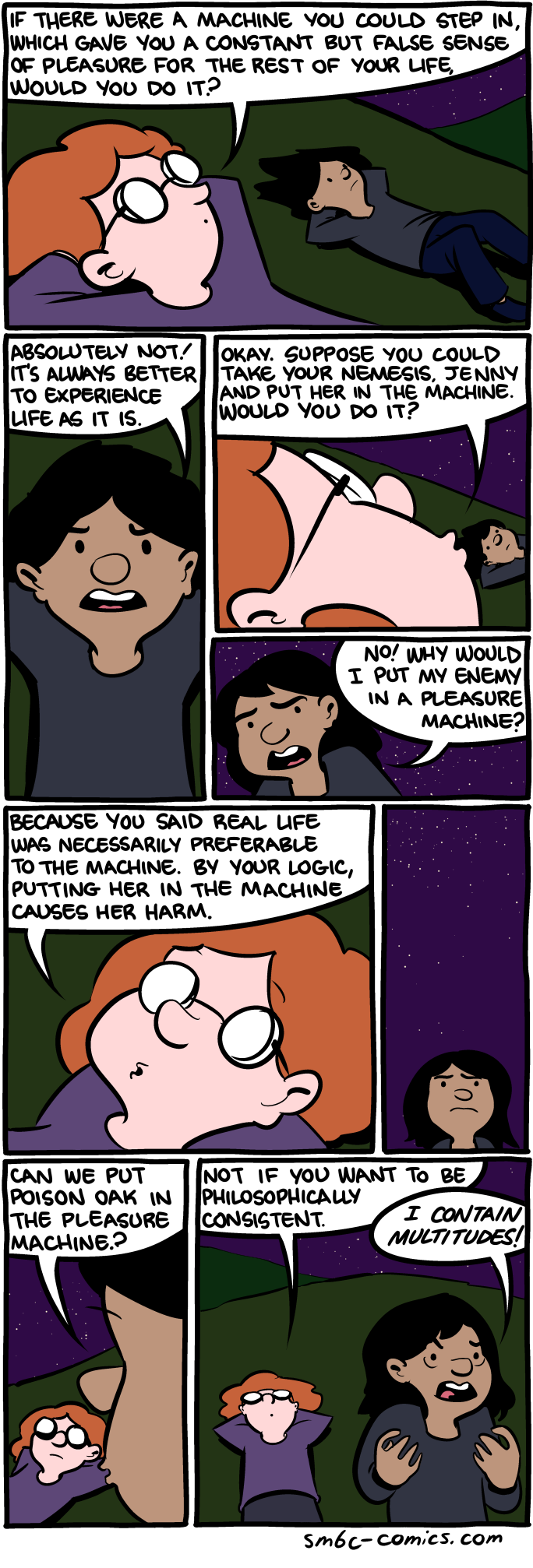
A philosophical thought experiment: (SMBC Comics)
To finish off the links, here are some funny videos in increasing order of derangement.
You better not think that thought! (Chris & Jack). A mad scientist implants a thought bomb into the brain of super spy Axel Wolf.
That Scene in a Christopher Nolan Film When You Give Up Trying to Follow the Story (Michael Spicer).
Mom Hid My Game. Dunkey plays a few strange games.
laddergoat (Dopelives). laddergoat
Notes
-
Civitarese, A. E., Carling, S., Heilbronn, L. K., Hulver, M. H., Ukropcova, B., Deutsch, W. A., Smith, S. R. et al. (2007). Calorie Restriction Increases Muscle Mitochondrial Biogenesis in Healthy Humans. ↩
-
Elden Ring does have a PvP mode but I’ve never tried it. ↩